
When we hear the word “image” most of us immediately associate that word with a picture or visual. Yet our image of Jesus can be so much more…it can be a story, a personality, or characteristics that make up who we believe Jesus to be. I spent some time talking with a friend and colleague, Rev. Joya Abrams, an ordained elder in the UMC, about her image of Jesus, and how it is unique from the stereotypical visuals we see in the church.
Starting at the beginning, I asked—What’s your favorite image of Jesus? “I don’t really think in terms of images of Jesus because none of them are accurate for me. I disregard images because they are all wrong.”
I can understand this response, because I have yet to find an image that I find “all right.” It’s hard to find common imagery in America that portrays Jesus as historically accurate. Digging deeper, I ask Joya what images she grew up with…what were the first images she remembers. “Even though I grew up in a completely Black United Methodist Church, we had the pictures of Barbie Jesus (blond hair, blue eyes, pale skin).”

When I first began researching imagery of Christ and its impact in churches, I was very surprised to find that the popular Warner Sallman piece “Head of Christ” was not only common in predominantly White churches, but also in predominantly Black churches. This wasn’t an image just to appeal to individual cultures to make Jesus seem more relatable; it was being portrayed as the one “true” image of Jesus. One of my congregation members who grew up in Nigeria confirmed that they too had images of Jesus with white or light skin as the predominant image. It wasn’t until much later that her culture began adapting an image that more closely resembled the people in the pews.
Returning to Joya’s upbringing in the church, I inquired further. Why would a Black church have imagery of White Jesus? “White Jesus was the assumed Jesus. When I was in high school in the mid-90’s, that was the first time I started hearing any biblical translations besides the KJV. Our church finally began experiencing or acknowledging the discontinuity of how White Christians treated Black people. The people around me started becoming more and more aware of a chasm between how people were treated. I think that the late 20th century saw African American studies in colleges begin to rise and people finally had permission to question why we had this image in our churches; to ask why is this who Jesus is to us? Even before that I had friends who could get behind Jesus’ teachings or what the Bible said about Jesus, but they had no room for White Jesus. That image has been quite a barrier.”
Much of our imagery where Jesus appears White or European is either derived from the artist’s own comfort zone and familiarity, or intending to portray Jesus as relatable to a common audience. Around the world there are images of Black Jesus, Asian Jesus, and a variety of ethnically diverse imagery that appeals to a certain race and culture. But this relatability is not what appeals to Joya, who is more interested in an authentic Middle Eastern depiction. “I’m not even interested in Black Jesus because that’s still not what he looked like. I’m not interested in Dreadlock Jesus. I would love to know what he actually looked like.”
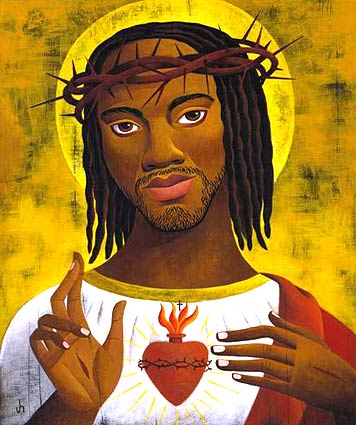
“When I think about images it’s not just the visual but the characteristics that are lain on him that are part of the White culture because it’s not actually Biblical. Somehow we’re reverse interpreting…the triumphalism. Jesus didn’t point to his own power. He pointed toward his Father’s power. He used his power to heal people. He used his power to bring people together, not divide them. It wasn’t my victory over and above yours. It was the wholeness of all creation that the kingdom of God has come.”
Understanding Jesus through scripture is largely left to interpretation, and society tends to focus on a few key aspects of Jesus’ character through scripture. Even in secular settings like sporting events we see reference to John 3:16 promising eternal life to anyone who believes in Jesus. Yet limiting our understanding of Jesus to that one verse is detrimental when it is used as a type of gatekeeping for who is out and who is in. When we continue with John 3:17 we’re reminded that condemnation was not the goal. Joya confirms “the world is condemned by its own actions, not by not believing in Jesus, but by living in a world that’s hateful. Jesus is about wholeness but White Jesus is about triumphalism and White victory over everyone else. The Christian culture purveys these ideas that act like a force field that repels people who are hurting and actually need the Gospel. We’re damaging our brand and it’s a lot bigger than just a visual…it’s an idea, perception, impression that our culture has of us.”

Many of our visuals portray Jesus as meek and mild, especially in Christmas hymns about the holy infant. But Joya feels that seeing Jesus in such a passive way in adulthood does damage to his character. “When we read scripture, he wasn’t nice. He didn’t sit around and just let people roll over him. He was passionate and strong spoken. He verbally wrestled with people and helped them see another way of thinking. He never gave anybody a pass. He told you when you were being unfaithful. I think by painting Jesus as this kind of passive, un-human thing, we take away the reality of the incarnation. He felt things and was able to sit with people and get dirty with them, then turn over tables in the temple. Clearly he wasn’t having a great day and he had a temper. We need to be able to see how that’s holy.”
“A lot of our tradition comes from images and not actual words [scripture]. Especially when people were illiterate and didn’t have a theological education, they didn’t know how to interpret scripture or even translate it from the original Aramaic or Greek. So much of how we understand our religion is mediated by somebody else. So few people realize that.”
Whenever we have an image of Jesus, we have to come to terms with the idea that it only portrays a portion of who Jesus is, and never a fully authentic and accurate visual. Yet it is also time to take a deeper look at how the church is portraying Jesus to the world, and how our cultural assumptions of Jesus’ characteristics have caused harm and separation throughout the church. Whether we attribute the quote to Malcom X or Martin Luther King, Jr., it appears that even today Sunday morning is still one of the most segregated hours in our nation. Perhaps it largely comes down to how Jesus is portrayed.
 Facing Jesus