
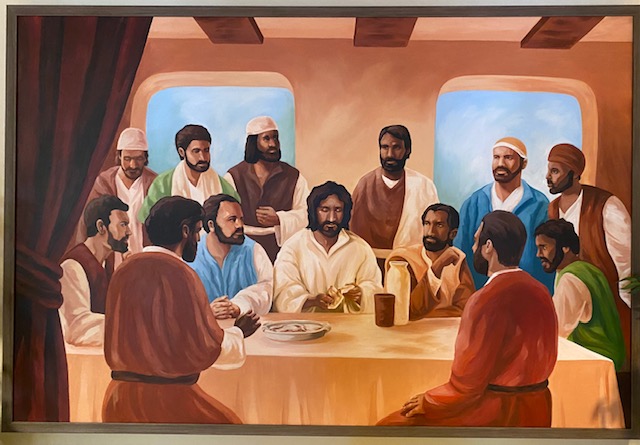
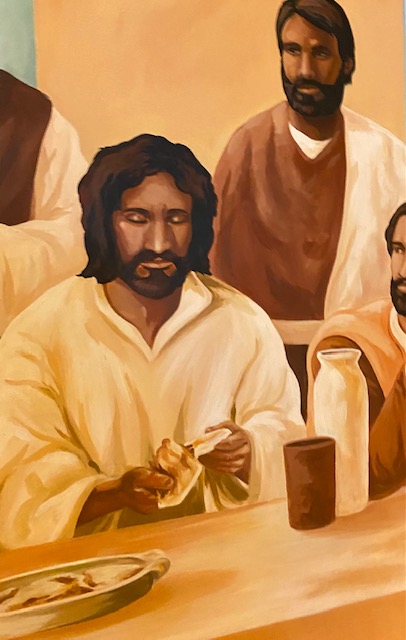
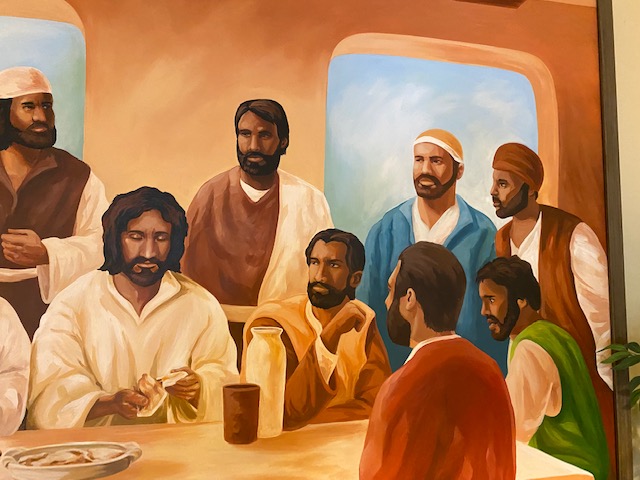
Several months ago I started taking art lessons. As I’ve been studying Christian imagery and the implications it can have on an audience, I wanted to get a slightly better understanding of art theory and technique. I signed up for lessons at my local art studio, The Sketching Pad, in Conyers, GA. One day as I walked in to meet my instructor, a new unfinished painting caught my eye. Larger than the typical 8×10 canvases, this wall hanging portrayed what was easily recognizable as an interpretation of The Last Supper. Even partially finished, I could tell this image was different, most notably that the skin tones were not White.

“What is that?!” I asked, instantly intrigued. “Oh, that’s a commissioned piece we’re working on for a church,” they responded, as if it was the most ordinary daily task. I asked more about it and found out that a member of the nearest church, Conyers First UMC, had asked for a piece of artwork that would portray a more authentic image of Jesus and his disciples. After a little more investigation, I was able to sit down with the mastermind behind this piece, Ora Bailey.
Ms. Bailey is a lifelong member of Conyers First, and previous chair of their Leadership Board. Over the last several years, the pastors and leadership have been working hard to shift their church’s image as one that is more relatable and community oriented. The church, whose membership has historically been predominantly White and affluent, recognized that they were no longer reflecting the makeup of their community, which the leadership wanted to address.
Conyers Georgia has experienced a great amount of growth and change over the last ten or so years, and with that the town has become a lot more culturally and racially diverse. The charming local drugstore where we sit and talk, and where Ora works, also has a food counter that serves sandwiches and drinks. She remembers the history of the store when the community was more divided. “I have stories about when there were stools put in at the counter, and people would fight over who was allowed to sit there. That’s not an image you want to ever portray.” Seeing the change and growth in her own store has led her to become an advocate for change in other areas, like her church.
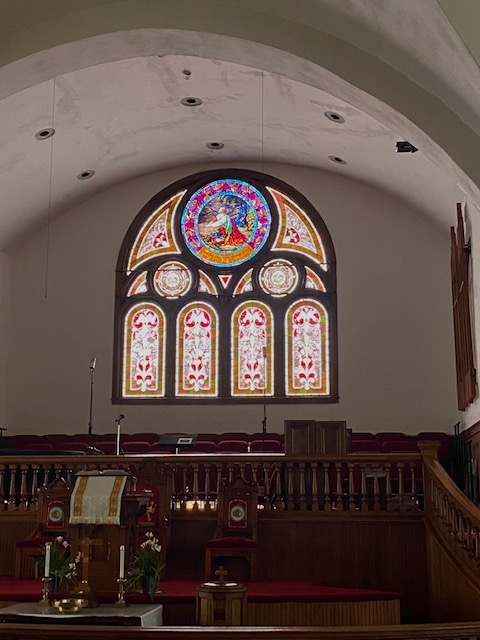


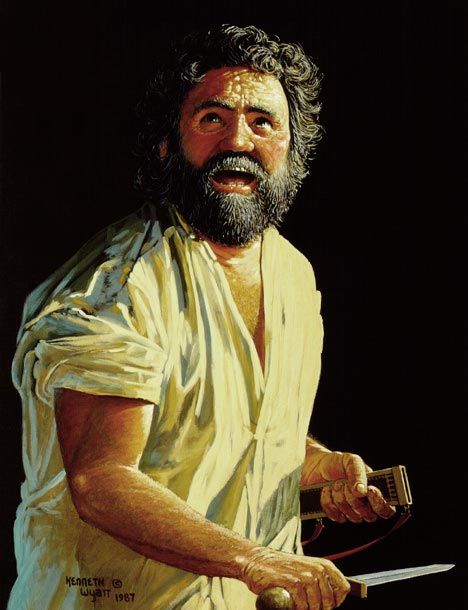
Like most churches, the current artwork hanging in the walls reflects the typical images of Jesus looking European or White. There’s a stained glass window in the Sanctuary with Jesus praying in the garden, which is the first image Ora remembers from her childhood. “It never occurred to me to question it,” she says. There’s also a series of paintings depicting Jesus, Paul and the 12 apostles by Kenneth Wyatt. This series is quite popular in churches around the area, and while beloved by many, they lack any authentic characteristics of first century Israeli men. Ora remembers conversations around these images and how they lack inclusivity. “They’re lovely portraits, but they’re all White apostles. We wanted to move away from all White imagery, but no one was saying it out loud.”


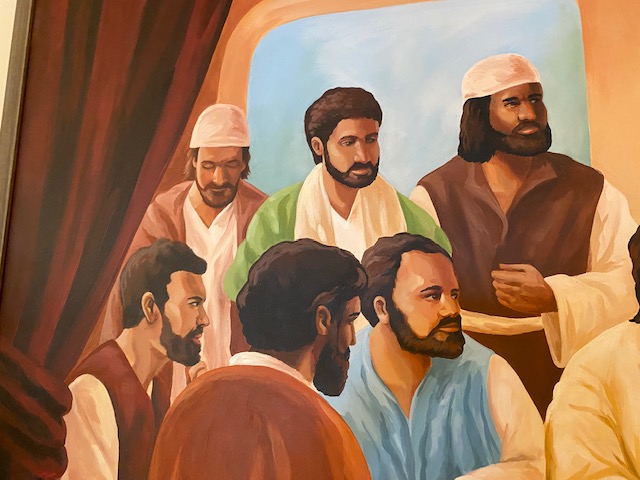
With compassion and courage, Ms. Bailey sought to create a gift for the church that would take a small step in normalizing different skin tones and hairstyles. She worked with the artists at The Sketching Pad to commission a more authentic version of The Last Supper that could hang in the church depicting Jesus and his disciples with more Middle Eastern characteristics. “We need a more open worldview and to be more inclusive on all fronts.” It was her hope that offering an image of people with brown skin would give a bit of representation to people who might walk into the church.
When asked what her goal was with commissioning a piece that showed Jesus in a new light, she smiled and said, “Shock. I think people need a bit of a jolt. I hope people will look at it and be accepting of it.” She’s not just talking about accepting an image, but accepting people who may not look like their typical members. Her compassion is evident in recognizing that welcome and hospitality starts in the small details.
“I really hope we can get to a place where we’re reaching out to everyone in our community to make them feel welcome; I think it’s really important. We can’t touch people’s hearts if we feel we’re one step removed or that we’re different or special.” There is an implication that when we only portray Jesus as White, when we remove Jesus’ ethnicity, it is because we think Whiteness is the superior race. There is simply no room for that in the church. I give thanks for Ora’s mindfulness and courage to continue this conversation and bring awareness to others. The beautiful finished piece, painted by Laura Walters, Gabby Howard, and Megan Illick, now hangs outside the Sanctuary at Conyers First UMC.
A single image may not be enough to transform an entire community, but it is enough to make people think when they see it. Recognizing that Jesus wasn’t White and didn’t look like “us” includes not just the imagery hanging in our halls, but the theology taught in our sermons and the witness shared in our communities. So much of Jesus’ ministry focused on reaching out to those who were excluded. Changing that narrative may start with an image, but it can expand in how we treat our neighbors and intentionally welcome those who may have felt left out in the past.
 Facing Jesus